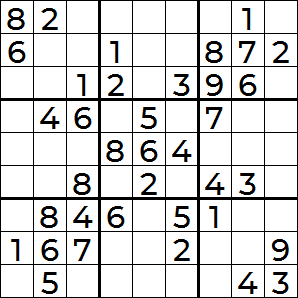
 Classic
Sudoku Variants
Classic Sudoku
Classic Sudoku is the most popular form of sudoku. Fill the grid so that each number appears exactly once…
Non-Consecutive Sudoku adds an extra challenge to the classic puzzle. Follow the standard Sudoku rules, but make sure that horizontally and vertically adjacent cells never contain consecutive numbers.…
Also known as: Nonconsecutive Sudoku, Non-Consecutive Sudoku
Non-Consecutive Sudoku adds an extra challenge to the classic puzzle. Follow the standard Sudoku rules, but make sure that horizontally and vertically adjacent cells never contain consecutive numbers. In this wrap-around version, cells on opposite edges of the grid are also treated as adjacent.
Keep these rules in mind while solving.
Follow the standard Sudoku rules: each row, column, and box must contain every number exactly once.
Orthogonally adjacent cells must not contain consecutive numbers.
Numbers are consecutive when they differ by exactly 1, such as 2 and 3 or 5 and 6.
Cells that touch only at a corner are not considered adjacent.
The non-consecutive rule applies to every pair of horizontally or vertically adjacent cells.
The grid wraps around its edges: the first and last cells of each row are treated as adjacent.
The first and last cells of each column are also treated as adjacent.
A calm path from the first observation to the final answer.
Begin by checking the rows, columns, and boxes. Eliminate any number that already appears in the same row, column, or box.
For every placed number, examine the cells directly above, below, left, and right. These adjacent cells cannot contain a number that is one lower or one higher.
If a cell contains 3, remove 2 and 4 from all orthogonally adjacent cells. Continue applying this rule whenever a new number is placed.
When a cell can contain one of two consecutive values, both values may be eliminated from an adjacent cell. For example, if a cell is either 3 or 4, an adjacent cell cannot be 3 or 4.
Remember that opposite edges are connected. The first and last cells in each row must be non-consecutive, and the top and bottom cells in each column must also be non-consecutive.
A valid number must satisfy both the standard Sudoku rules and the non-consecutive rule. Compare every candidate with its row, column, box, and adjacent cells.
Continue scanning the grid, removing impossible candidates, and placing numbers with only one valid position until the puzzle is solved.
Classic
Classic Sudoku is the most popular form of sudoku. Fill the grid so that each number appears exactly once…
Make sure no number repeats among the white cells in any row or column, no black cells share a…