Cell Coloring
Hitori
Make sure no number repeats among the white cells in any row or column, no black cells share a…
Nonograms are picture-forming logic puzzles in which numerical clues reveal which cells must be filled and which must remain empty. Solve the rows and columns step by step to uncover a hidden pixel-art image.
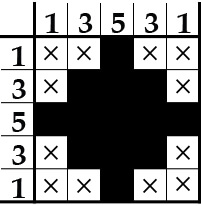
A Nonogram is a logic puzzle played on a rectangular grid. Numbers appear beside every row and above every column. These clues describe groups of consecutive filled cells.
By comparing the row and column clues, the solver determines which cells must be filled and which must remain empty. When every clue has been satisfied, the completed grid reveals a hidden picture.
Each number represents the length of one uninterrupted group of filled cells.
For example, the clue:
5
means that the line contains one group of exactly five consecutive filled cells.
The clue:
3 2
means that the line contains:
The groups must appear in the same order as the clues.
For example:
1 4 2
means that the line contains a group of one filled cell, followed later by a group of four filled cells, and finally a group of two filled cells. There must be at least one empty cell between consecutive groups in a standard black-and-white Nonogram.
The following symbols are commonly used while solving:
Marking empty cells is just as important as filling cells. Empty cells limit the possible positions of the remaining blocks and often create the next logical step.
Consider a line containing ten cells.

The line contains one continuous group of four filled cells.

There is a group of three cells, at least one empty cell, and then a group of two cells.

Because the blocks and required spaces fill the entire line, every cell can be determined immediately.
Consider this simple 5×5 Nonogram.
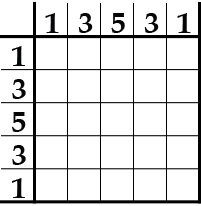
Row 3 has the clue 5 in a five-cell grid. Therefore, every cell in Row 3 must be filled.
Column 3 also has the clue 5, so every cell in Column 3 must be filled.
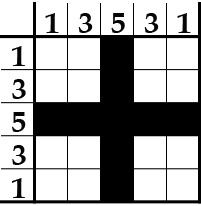
Row 1 has the clue 1, and its centre cell is already filled. Therefore, every other cell in that row must be empty.
The same applies to Row 5.
Column 1 also has the clue 1, and its centre cell is filled. All other cells in that column must be empty.
The same applies to Column 5.
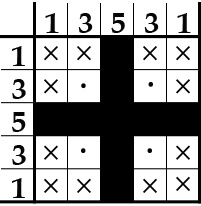
Rows 2 and 4 each have the clue 3. Because the first and last cells are already marked empty, the three centre cells must be filled.
The completed Nonogram reveals a diamond-shaped picture.
Make sure no number repeats among the white cells in any row or column, no black cells share a…